
HAND PROTECTION
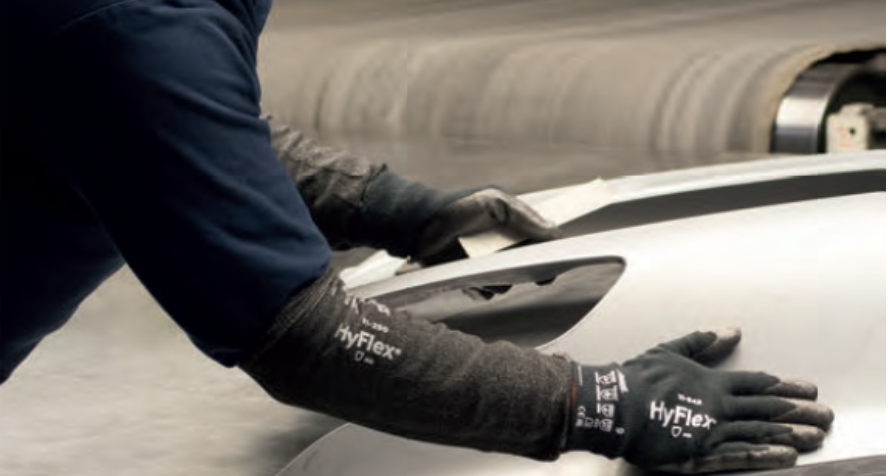
There is a large variety of occupational protective gloves to protect workers from a range of workplace hazards that includes mechanical, thermal, cold, cutting and stabbing, chemicals, vibration, biological and ionisation energy. Australian and International Standards specify various requirements for different type of risks.
Type of Risks
Cut Risks
Cut resistant gloves are specifically designed for protection against sharp objects such as blades, glass and metals. Gloves in this category offer enhanced protection compared to similar looking general purpose gloves.
Cut resistant gloves range from level 1 to Level 5 (highest protection) according to the Internationally recognised European Standard DIN EN 388.
Gloves made of Kevlar offer the highest cut resistance.
Mechanical Risks
The standard DIN EN 388 also describes the requirements of safety gloves against mechanical risks when carrying out work. This includes resistance to abrasion, tear and puncturing.
Thermal Risks
The European standard DIN EN 407 regulates the minimum requirements and specific test methods for safety gloves in relation to thermal risks. This includes protection from ignition, contact heat, convective heat, thermal radiation, and droplets of molten metal.
Electrostatic Risks
For workplaces with a risk of fire and explosion, the European standard DIN EN 16350 defines the test conditions and minimum requirements for the electrostatic properties of safety gloves.
Electric Shock Risks
When it is necessary to work on “live installations” then insulated gloves must be used by the Authorised person to the highest potential voltage. Insulating gloves offer personal hand protection for workers against electrical shocks when working near or on live wires, cables and electrical equipment including substation switchgear and transformers.
There are 6 different classes ranging from a usage voltage of 500V to 36,000V.
Class 00 (500V) can be used for 415V, Class 0 for up to 1000V, Class 1 to 7500V, Class 2 to 17,000V, Class 3 to 26,500V and Class 4 for up to 36,000V.
Leather work gloves may be considered for de-energised electrical work.
Type of Glove Composition
General purpose
This broad glove category consists of many different designs and materials. Generally, they are intended to provide protection from dirt and mechanical hazards (such as sharp or abrasive objects). Some types are also liquid proof, but generally offer low levels of chemical protection.
Natural Rubber (Latex)
Natural rubber is widely used for gloves because it is relatively inexpensive, and yet offers good resistance to certain groups of chemicals (such as acids). Rubber has good resistance to abrasion, cuts, tears, and punctures; rubber is very comfortable and provides excellent dexterity. Natural rubber can be an economical alternative to nitrile or neoprene.
Nitrile
Nitrile offer excellent protection against acids, bases, oils, solvents, esters, grease and animal fats. Nitrile is more resistant to snags, punctures, abrasions and cuts than neoprene or PVC gloves, and unlike natural rubber gloves, contains no natural rubber proteins which can cause allergic reactions. Nitrile gloves are versatile and ideal for applications, including chemical processing, food processing, petroleum refining, dip tank operations and more.
Leather
Leather has been traditional used due to its relative low cost, abrasion resistance, and ability to withstand high temperatures and hazards such as weld spatter. There are many different types and grades of leather available, and care is needed to ensure the desired level of performance is achieved.