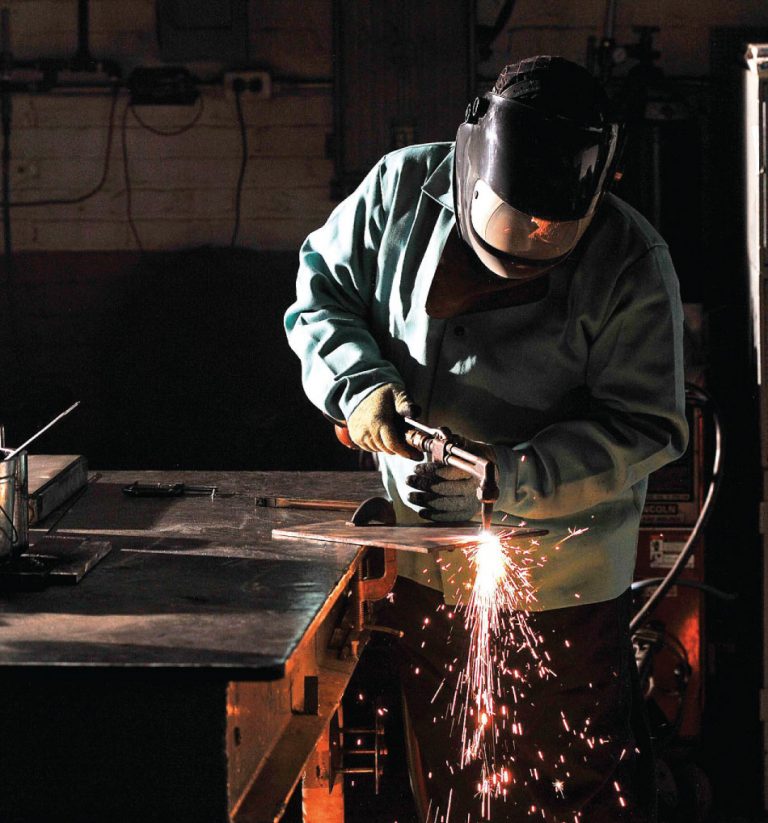
Workwear is the clothing worn to protect a worker from the working environment that includes shirts, polos, jackets, vests, aprons, pants, shoes and jackets.
Clothing referred to as industrial clothing comes in hi visibility so that the worker can easily be seen from a distance. Although all reflective tape is designed to increase the visibility of the worker there are different types for different working environments.
The weight of clothing can also vary ranging from lightweight to regular weight, and some workwear is designed to offer increased protection from the work environment, such as additional ventilation for hot, humid conditions and even insect repulsion in the tropical areas where there is a high presence of insects.
Specialist Technical Workwear
In certain working environments there is a requirement for specialist workwear.
Flame Retardant (FR) Clothing
Fire retardant (FR) clothing is used to provide the necessary thermal protection to shield workers at the moment of exposure to flash fire, electrical arc flash and molten metal splash. Once the source of ignition is removed flame resistant garments are designed to self-extinguish. This greatly reduces the severity of a burn, and in many cases the difference between a minor injury and a serious injury or fatality.
Arc Rated Clothing
Arc rated clothing is designed to protect against electrical hazards. High Risk Categories (HRC) are determined through Arc Thermal Protection Values (ATPV), and those values are defined as Arc Ratings.
An Arc Rating is expressed as calories/cm2, ranging from 1.2 to 40 (cal/cm2).
The higher the HRC numeral the higher the protection, ranging from 0 to 4. Where 0 represents an Arc Rating of 1.2 (cal/cm2) while 4 represents an Arc Rating of 40.
Workplace hazards where fire retardant and Arc rated clothing is required include the following:
Fire, sparks and molten metal
Welding and metal fabrication
Mining
Chemical manufacturing
Aluminium smelting
Oil and Gas
Firefighting
Electrical Static
Mining
Chemical manufacturing
Oil and Gas
Firefighting
Arc Flash
Electrical maintenance
Electrical installation
Protective clothing for welding is designed to protect the worker against molten metal drops, but also protects against short contact with flame and radiant heat from an electric arc (plasma) that is used for welding. In addition to this, the clothing also minimises the possibility of electric shock.
Chemical Protective Clothing
Chemical resistant clothing offers protection against hazardous chemicals and biological agents. This includes, overalls, coveralls, nitrile gloves and footwear, used in conjunction with suitable respirators.
The level of protection required depends on the chemical or biological agent and its toxicity.
The resistance of a protective clothing fabric to permeation by a potentially hazardous chemical is determined by measuring the breakthrough time and the permeation rate of the chemical through the fabric.
Breakthrough time (BT) is the average time between initial contact of the chemical with the outside surface of the fabric and the time in which the chemical is detected in the inside surface of the fabric.
Permeation is the process by which a hazardous chemical moves through a material on a molecular level. Permeation rate (PR) is the rate in which a hazardous chemical permeates through the test fabric and is expressed as a mass of hazardous chemical flowing through a fabric area per unit of time i.e. 1.0μg/cm2/min.
The Standard AS/NZS ISO 6530 based on the European EN ISO 6530 gives 6 levels of permeation, ranging from immediate penetration (level 0) when in contact with the chemical, to over 480 minutes exposure to the chemical (level 6) without permeation detected.